Yet another reason to research your carriers
http://www.foe.org/pdf/Killer_Cribs_Report.pdf
Sunday, June 29, 2008

Thursday, May 15, 2008
Wednesday, May 7, 2008
What To look for in a baby carrier
What To look for in a baby carrier
Mei Tais
Strap fabrics need to be a strong heavy weight( twill, denim,canvas)
Mei Tais Panels, should have 3 layers an inner layer of canvas, with an additional layer of the above fabric, 1 addtional layer is good 2 is best.
Where straps join the body, there should be x-boxs/reinforcment type stitching. If you don't see this type of stitching on the front look at the under side. Some manufacturers make these stitches on the bottom 2 layers.
Pouch slings
Slings should be constructed with a layer of home decorator weight fabric twill, denim, canvas. There are carriers of this type that have fancy fabrics, brocade silk etc. Just check that they are double layered pouch slings.
Seams on pouch slings should be french/felled combination seam, There should be more than 1 line of stitching on the outside of the carrier. Ask the maker if there are 3 lines of stitching. 3 is good, 4 is best. Also be sure a premium quality, or heavy duty thread is being used. You do NOT want a cheap thread all weight bears on this stitching alone.
Ring Slings
Ask the maker which rings are used? are they weight tested? Any decent ring has been weight tested.
SHoulder stitching, Your shoulder should have at least 5 lines of strait stitching.
3 lines of stitching can be sufficient if a premiem quality thread is used.
Fabrics should be a woven med weight material.
Quilters cotton should NOT be used for slings.This fabric is intented for quilting, some of these fabrics are 2-5 oz. weight fabric. Sling fabric should be a fabric around 7 Oz weight. Some online fabric retailers have this information posted.
Brocades and silks should NOT be used in a sling as a single layer. These fabrics can be used with an additional layer of suitable sling fabric.
With the exception of
Dupioni and Shantung (silk) is sometimes used in a single layer with light weight babies (under 20#)
Saturday, April 26, 2008
Thursday, April 17, 2008
The invention of the ring sling
Saturday, April 12, 2008
Babywearing around the wourld!
http://www.flickr.com/groups/ethnicbabycarriers/pool/show/
This is a beautiful pictorial of babywearing around the wourld. This would make everyone want to wear a baby. There are many types of carriers. I will go into each carrier in the feature. I plan to post weekly. SHowing different types of carriers. how to wear them, positionioning, DIY info as well as needed safety information. Please read over safety information before wearing your baby. Also i am available to answer any questions.
This is a beautiful pictorial of babywearing around the wourld. This would make everyone want to wear a baby. There are many types of carriers. I will go into each carrier in the feature. I plan to post weekly. SHowing different types of carriers. how to wear them, positionioning, DIY info as well as needed safety information. Please read over safety information before wearing your baby. Also i am available to answer any questions.
Friday, April 11, 2008
Positioning your Newborn safely
Please read over the positioning safety information in the following link, before wearing a very young baby.
http://www.familialibre.com/pages/sling-correct-positioning.php
If you are douls, CBE, Midwives etc. And would like a reproducable copy of the positioning information sheet. There is a copy available at my yahoo group in the files section.
http://groups.yahoo.com/group/milkcolorcarriers/files/
http://www.familialibre.com/pages/sling-correct-positioning.php
If you are douls, CBE, Midwives etc. And would like a reproducable copy of the positioning information sheet. There is a copy available at my yahoo group in the files section.
http://groups.yahoo.com/group/milkcolorcarriers/files/
DIY pouch information
Please read over pattern, fabric, and thread details before you begin construction of your pouch. You are ultimately responsible for your child. Please be safe. Information supplied here is provided for PERSONAL USE ONLY
ABout fabrics
You want to use at least one layer of bottom weight fabric. If you are used a double layer application one of the following fabrics may used along with a bottom weight fabric.
DO NOT use single layer quilters cotton, this is meant to used in a 3 layer application. It is NOT suitiable for single layer.
DO NOT use single layer Batik, hot wax is used in the dying process which can weeken the fabrics fibers.
DO Not use single layer brocades, This fabric can unravel much to easily, especially at the seams.
DO Not use single layer silks unless you have a familiarity with silks,
Shantung and Dupioni are sometomes used in singlr layer up to about 20lbs.
These silks are quite strong, check your seams everytime.
THREAD & SEAMS
Pemium quality poly thread should be used in this application, along with the proper seam application. French seam reinforced, for a totl of 3-4 seams along the pouch curve.
Bottom weight
Finally what is bottom weight fabric, Thing pants commonly anything that is used in the manufacturing of pants. Hense bottom weight.
This includes denims, twills, suiting, home decorator fabrics, canvas, ducks. Most of these fabrics are 9oz weight or above.
KNIT FABRIC INFO
You will see in the Mamatoto pattern they use a tshirt (knit fabric) This type of pouch is commonly used for very young babies. POSTIONING IS CRUCIAL IN THE NEWBORN< READ SAFTY POSITIONING INFORMATION PRIOR TO USING ANY CAARRIER, ESPECIALLY WHEN USING A CARRIER WITH A YOUNG/ NEWBORN BABY. It will become too stretchy once your baby begins to grow. It is a great way to try out the idea of a pouch. However i wouldn't recommend it for daily use with a heavier babe. ALWAYS CHECK YOUR SEAMS PRIOR TO EVERY USE.
Pouch patterns
http://www.mykarmababy.com/pages/BabySlingPattern.php
http://www.mamatoto.org/Default.aspx?tabid=128
http://www.sleepingbaby.net/jan/Baby/tubesling.html
http://www.sweetthingsbabyslings.com/custom_pouch_super.html
Saturday, April 5, 2008
Friday, March 28, 2008
The importance of leg positioning and hip dsyplasia
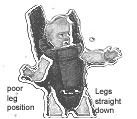
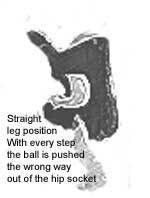
Baby carriers are very easy to handle, however, quality varies between manufacturers so you should choose carefully. The most important considerations are correct leg position, sufficient back support, and stabilization of the head.
You should first check the leg position of your baby; most baby carriers do not ensure the correct positioning. Some carriers have openings where the baby’s thighs hang almost straight down. This design does not provide adequate support. In some cases, a squatting leg position is not only impossible, but in the face-to-face orientation, the thighs and knees of the child are pressed up against the adult. With each step of the baby wearer, the child’s knees are pushed backward. When this happens, the additional pressure from the child’s thighs increases the amount of stretching on his or her hip joints.
When looking at tube slings or ring slings, watch for slings that are too short. The entire bottom of the sling, even when used with a four month old infant, hardly reaches up underneath the shoulder blades. With most of these slings, the suggested age is 3-4 months, however, even at that age these types of slings do not stabilize the back and shoulders sufficiently. Although these carriers seem practical, they simply do not offer your baby sufficient support, especially on prolonged walks.
Explaining Hip Dysplasia
The femur (thighbone) is the longest and strongest bone in the body. Proximally, the femur has the following: head which fits in the acetabulum of the coxal bone (hip socket) greater and lesser trochanters which provide a place of attachment for the muscles of the legs and buttocks; linea aspera, a crest that serves as a place of attachment for several muscles.
Ball-and-Socket Joints
In the ball and socket joints, the ball-shaped head of one bone fits into the cup-shaped socket of another. Movement in all planes is possible, as well as rotation. The shoulder joint and hip joint are examples of this type.
Hip Dysplasia can be either congenital (CHD) or developmental (DDH) and occurs when the top of the femur (leg bone) is not properly located in the hip socket or not located where the hip socket is expected to develop. Hip dysplasia in humans is normally diagnosed in babies. Statistically, girls have a higher incidence of hip dysplasia than boys. There are a variety of treatments that are used depending on the age of the child and the severity of condition.
Subscribe to:
Posts (Atom)